
Printed circuit boards, memory chips and communication equipment fuel diversification as electronics exports touch $31.97 billion in April–September 2026-27
Nov 19: India’s electronics exports are witnessing a significant transformation, with non-smartphone products emerging as a major growth engine alongside the country’s expanding smartphone shipments.
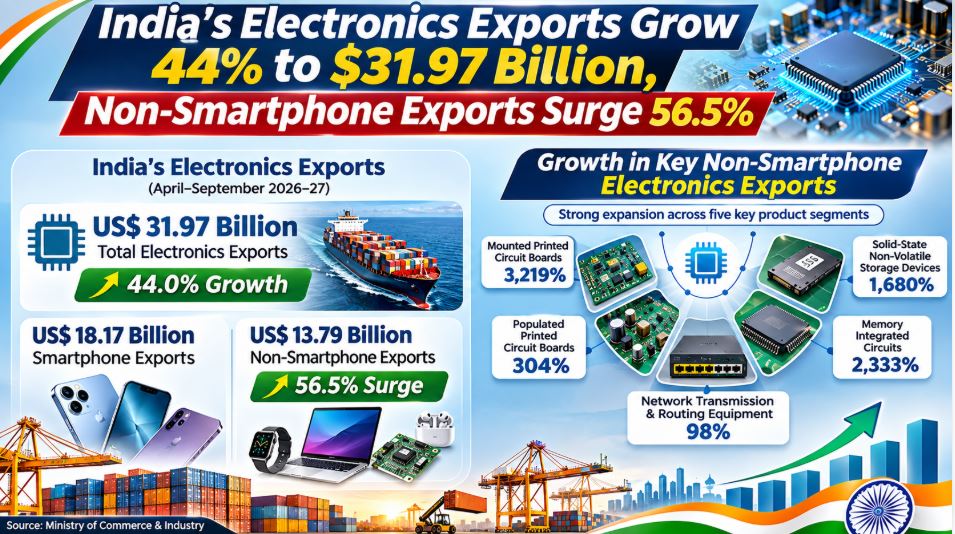
According to data highlighted by the Ministry of Commerce and Industry, India’s electronic goods exports jumped 44 per cent to $31.97 billion during April–September 2026-27, compared with $22.20 billion in the corresponding period of the previous financial year.
While smartphones continued to dominate the export basket, shipments of other electronic products registered considerably faster growth, signalling a gradual diversification of India’s electronics manufacturing and export base.
Non-smartphone exports grow 56.5%
Non-smartphone electronics exports rose 56.5 per cent to $13.79 billion during the six-month period, up from $8.81 billion a year earlier. Their share in total electronics exports increased from 39.7 per cent to 43.2 per cent.
The expansion was driven by strong overseas demand for printed circuit boards (PCBs), network transmission equipment, memory integrated circuits and solid-state storage devices.
Among the fastest-growing categories were mounted printed circuit boards, whose exports surged from $63.3 million to $2.10 billion. Singapore emerged as the leading destination, accounting for $1.87 billion, followed by China at $111.5 million.
Exports of populated or loaded printed circuit boards also recorded a sharp increase of 304 per cent, reaching $864.1 million against $213.7 million in the corresponding period last year. China remained the principal market, with shipments valued at $789.2 million.
Communication equipment and memory chips gain ground
Network transmission and routing equipment emerged as another important contributor to export growth. Shipments nearly doubled, climbing 98 per cent to $1.45 billion from $732.9 million.
Hong Kong was the biggest destination, with exports increasing to $857.7 million. The United States and the Netherlands accounted for $130.9 million and $124.4 million, respectively.
India also recorded a substantial rise in memory integrated circuit exports. Shipments jumped from $23.1 million to $562.4 million, representing growth of 2,333 per cent. Malaysia led the destination markets with imports worth $390.8 million, followed by Singapore at $102.4 million.
Solid-state non-volatile storage devices witnessed similarly strong momentum, with exports rising from $14.6 million to $260.5 million, an increase of 1,680 per cent. China, Singapore, Hong Kong and the United States were among the major destinations.
Smartphones retain the lead
Despite the rapid expansion of other electronic products, smartphones remained the backbone of India’s electronics exports.
Smartphone shipments increased 35.8 per cent to $18.17 billion during April–September 2026-27, compared with $13.38 billion in the same period of 2025-26.
However, their share in total electronics exports declined from 60.3 per cent to 56.8 per cent. This was not due to a fall in smartphone exports, but rather the faster expansion of other electronic product categories.
A more diversified export basket
The latest export figures point to a broader shift in India’s position in the global electronics trade. The country is gradually expanding beyond finished smartphone assembly into a wider range of electronic components, circuit boards, communication systems, memory products and storage devices.
The growing presence of Indian electronics products in markets such as Singapore, China, Hong Kong and Malaysia also highlights the increasing integration of domestic manufacturing into international supply chains.
With non-smartphone electronics growing faster than smartphones, the changing export mix suggests that India’s electronics sector is building a more diversified foundation for future trade growth.
The challenge ahead will be to sustain this momentum through deeper domestic component manufacturing, technological capabilities and stronger participation in global value chains.
Source: Ministry of Commerce and Industry, Government of India (PIB Backgrounder, November 19, 2026).