
New Delhi, Nov 28: India is stepping up efforts to help domestic exporters tap emerging global trade opportunities, with the Ministry of Commerce and Industry organising a series of outreach workshops in Jaipur and Dehradun to familiarise businesses, particularly Micro, Small and Medium Enterprises (MSMEs), with the benefits of Free Trade Agreements (FTAs).
Representational Image
The initiatives, held on November 27, brought together government officials, industry representatives, exporters and entrepreneurs to explore ways of expanding India’s international trade footprint through preferential market access, tariff concessions, investment partnerships and improved export infrastructure.
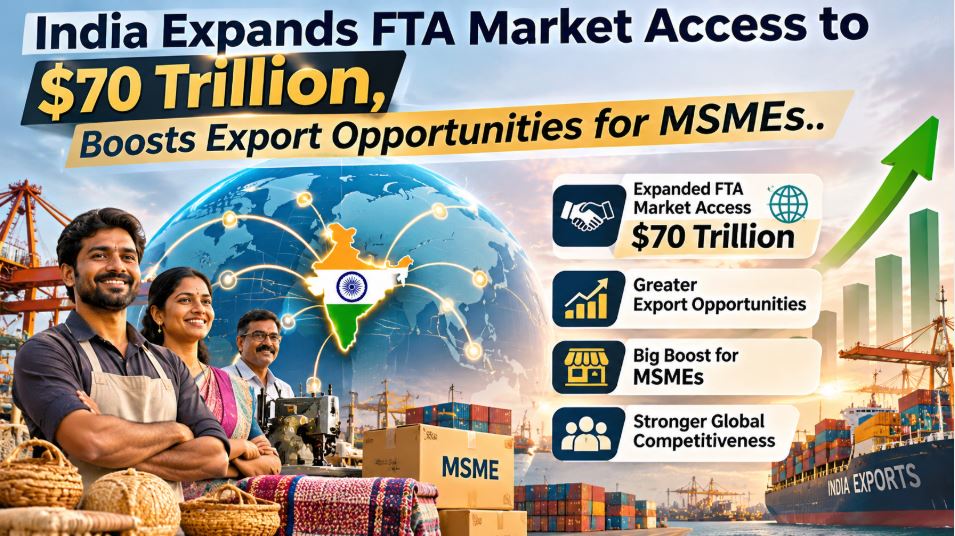
India’s preferential access to international markets has expanded significantly through its recent trade agreements. The combined market represented by these arrangements has grown to approximately $70 trillion and is expected to reach nearly $85 trillion, or around 76 per cent of global GDP, over the next 12 to 18 months as ongoing trade negotiations progress.
The government is now seeking to translate this expanded market access into tangible gains for Indian businesses, with a particular focus on export-oriented sectors, regional industries and smaller enterprises.
Rajasthan eyes ₹1.5 lakh crore export milestone
At the Jaipur outreach programme, organised by the Department of Commerce in collaboration with the Federation of Indian Export Organisations (FIEO), the Directorate General of Foreign Trade (DGFT) and the Rajasthan government, Commerce Secretary Rajesh Agrawal called upon exporters to make greater use of India’s FTAs to strengthen their international presence.
Highlighting Rajasthan’s competitive strengths in gems and jewellery, textiles, handicrafts, furniture and minerals, Agrawal encouraged businesses to identify opportunities in partner countries, participate in international exhibitions, build overseas supply chains and explore cross-border e-commerce.
Rajasthan’s exports reached $11.18 billion in 2025–26, with engineering goods, gems and jewellery, textiles and handicrafts emerging as major contributors. The state has set an ambitious target of achieving exports worth ₹1.5 lakh crore by 2029.
Several tariff concessions under India’s trade agreements are expected to improve the competitiveness of Rajasthan’s traditional and emerging export sectors.
Under the India-UAE Comprehensive Economic Partnership Agreement (CEPA), customs duty on whole cumin seeds has been reduced from 5 per cent to zero, opening new opportunities for farmers and farmer-producer organisations.
Similarly, the 5 per cent import duty on jewellery has been eliminated under the UAE and Australia agreements, while the United Kingdom agreement removes duties ranging from 2 to 4 per cent on jewellery. The UK agreement also provides duty elimination on garments and carpets, while the India-EU agreement is expected to remove duties on several textile and carpet products once it comes into force.
Agrawal also highlighted the Export Promotion Mission (EPM), which provides support for export credit, international exhibitions, testing and certification, overseas warehousing and logistics to improve the global competitiveness of Indian exporters.
India’s exports register strong growth
The outreach comes at a time when India’s external trade is recording encouraging growth. Exports of goods and services reached $568.84 billion during April–October 2026, registering an increase of 16.66 per cent.
In October alone, exports of gems and jewellery increased by 40.06 per cent, handicrafts by 55.22 per cent, carpets by 20.64 per cent and readymade garments by 20.33 per cent.
India has set an ambitious export target of $1 trillion for 2026–27, making greater utilisation of FTAs an important component of its export expansion strategy.
The New Zealand agreement, which provides 100 per cent duty-free access for Indian exports, is also expected to create fresh opportunities for MSMEs, artisans, farmers and women entrepreneurs. It includes provisions for 5,000 Temporary Employment Entry visas and 1,000 Working Holiday visas annually for Indian nationals.
Other agreements are expected to generate wider economic benefits. Under the India-EFTA Trade and Economic Partnership Agreement, the EFTA countries have committed to facilitating $100 billion in investment in India over 15 years, with the potential to generate one million jobs.
Uttarakhand focuses on MSME-led export growth
In a parallel initiative, the Ministry organised a state-level workshop on leveraging FTAs in Dehradun in collaboration with the Uttarakhand Industries Department.
The programme focused on connecting local MSMEs, entrepreneurs and exporters with international markets by creating awareness about tariff benefits, export procedures, market opportunities and government support mechanisms.
Uttarakhand MSME Minister Bharat Singh Chaudhary said the initiative would help integrate the state’s entrepreneurs and smaller industries into global supply chains. Referring to India’s development vision for 2047, he emphasised the importance of modern trade agreements in improving the international competitiveness of domestic products.
The state’s export performance has shown steady improvement, rising from ₹10,836 crore in 2017–18 to ₹13,802 crore in 2025–26. Pharmaceuticals, engineering goods, food processing, organic and herbal products, and handicrafts are among its leading export sectors.
Chaudhary also highlighted the state’s efforts to strengthen its industrial ecosystem. Through the Invest Uttarakhand single-window portal, in-principle approvals have been granted to 6,932 projects involving proposed capital investment of ₹70,397 crore over the past three years.
Uttarakhand has also secured first rank in its category in NITI Aayog’s Export Preparedness Index 2024 and the Investment Friendliness Index 2026.
To promote industrialisation beyond the plains, dedicated industrial parks are being established in Pauri, Chamoli and Almora. Following the development of the ₹194-crore Flatted Factory in Haridwar, similar plug-and-play facilities are proposed at Selaqui and Pantnagar.
The state is also developing an Integrated Manufacturing Cluster spread over 1,002 acres at Khurpia in Kichha, with an investment of ₹1,100 crore. A Multi-Modal Logistics Park in Haridwar and a Land Customs Station at Banbasa are expected to strengthen its trade and logistics infrastructure.
Initiatives such as House of Himalayas and Himadri are also helping traditional handicrafts, Aipan art, millets and products made by women’s self-help groups reach wider domestic and international markets.
Export Promotion Mission to strengthen smaller businesses
During the Jaipur programme, Joint Director General of Foreign Trade Moin Afaque highlighted the support available under the Export Promotion Mission, which has an outlay of ₹25,060 crore for 2025–26 to 2030–31.
The reimbursement framework has been expanded to cover 600 eligible certificates. In addition, MSME exporters from 308 more districts across 21 States and Union Territories can now receive reimbursement of transportation costs under the mission.
Joint Secretary in the Department of Commerce Mohit Yadav noted that FTAs offer opportunities beyond reduced import duties, including technology transfers, joint ventures and investment partnerships.
In Dehradun, senior officials from the Department of Commerce and DGFT provided detailed explanations of tariff concessions, Rules of Origin, the Export Promotion Mission and the Districts as Export Hubs initiative.
Experts from APEDA, SEPC, EPCH, EEPC, CII and PHDCCI also discussed sector-specific opportunities in agriculture, processed foods, handicrafts, services and engineering goods.
New trade agreements expand India’s global reach
India’s expanding trade engagement is creating new opportunities across several major economies.
The India-UK FTA, which came into force on July 15, 2026, provides zero-duty access to nearly 99 per cent of India’s exports. The agreement with Oman, effective June 1, 2026, provides duty-free access for 99.38 per cent of Indian exports by value. India also has operational trade agreements with the UAE and Australia.
The India-European Union agreement is expected to come into effect in early 2027. Under the agreement, duties will be eliminated on 70.4 per cent of the EU’s tariff lines, covering 90.7 per cent of India’s export value, with a further 20.3 per cent of tariff lines being phased out.
Meanwhile, India and the United States have announced a framework for an interim trade agreement, with negotiations continuing. The sixth round of India-Canada trade negotiations was held from November 11 to 20, 2026.
India is also pursuing trade negotiations with Chile, Peru, Israel, the Eurasian Economic Union, Mexico and other partners.
The workshops in Jaipur and Dehradun underline the government’s efforts to ensure that the benefits of international trade agreements reach businesses at the state and district levels.
With expanded market access, improved export infrastructure and targeted support for MSMEs, India is looking to turn its growing network of trade agreements into stronger exports, greater investment and employment generation.