New Delhi, Feb 3 : As India’s population ages at an unprecedented pace, experts at the Illness to Wellness Conference on “The Role of Geriatric Care in Promoting Healthy and Graceful Ageing” underscored the growing challenges facing the country’s elderly population and the urgent need for more responsive, inclusive, and community-driven approaches to geriatric care.
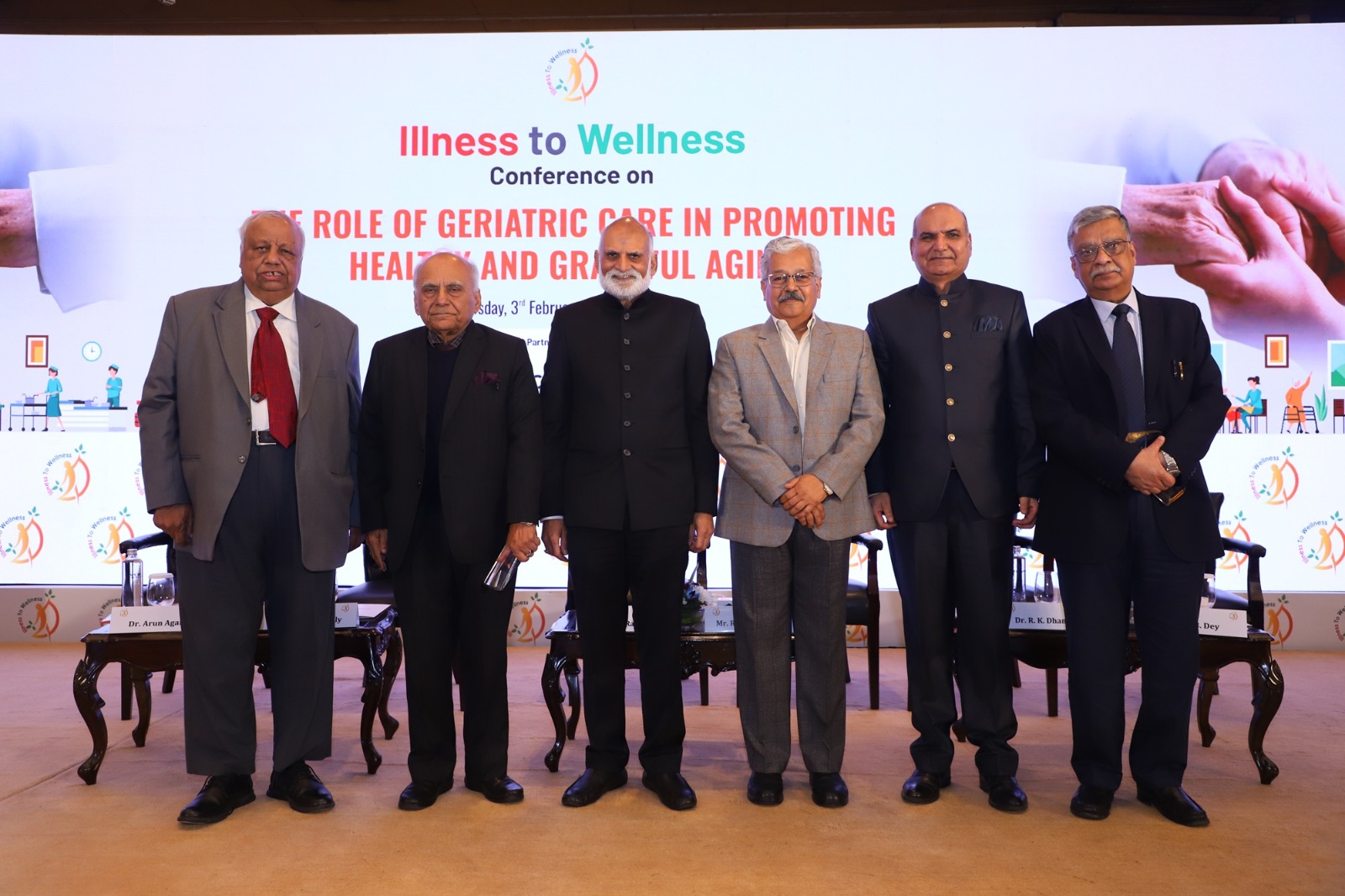
Speakers highlighted that the challenges confronting older adults are multi-dimensional, encompassing rising disabilities and age-related conditions such as dementia and Alzheimer’s disease; significant gaps in geriatric healthcare infrastructure; a pronounced urban–rural divide in access to medical services; and mounting economic pressures arising from inadequate social security and escalating healthcare costs. Participants also drew attention to a widening digital divide, with many seniors struggling to adopt technology due to limited access and lack of age-friendly training, as well as physical infrastructure—including public spaces, transport systems, and emergency response mechanisms that remains poorly equipped to support the safety, mobility, and independence of older persons.
Against this backdrop, the conference brought together senior government leaders, medical experts, and public health practitioners to deliberate on preventive care, mental and neurological health, assistive technologies, nutrition, and lifestyle interventions. The discussions emphasised the need for integrated, community-based and home-led geriatric care models that address both the medical and social dimensions of ageing.
Delivering the keynote address, Mr. Rajesh Bhushan, Former Secretary, Ministry of Health & Family Welfare, Government of India, and Chairperson, Governing Council, Illness to Wellness Foundation, stressed that geriatric care must be recognised as a core public health priority, on par with mental health and non-communicable diseases.
“Geriatric care cannot remain confined to a few tertiary hospitals or centres of excellence. In a country as large and demographically diverse as India, care must begin at home and be strengthened through district-level systems. Many elderly health needs do not require hospitalisation and can be effectively managed through trained caregivers, home-based services, and coordinated community support. The real challenge lies in scale, integration, and last-mile delivery,” he said.
Mr. Bhushan also highlighted the need to repurpose and upskill general physicians, integrate social care with medical services, and draw lessons from countries such as Japan and South Korea to develop unified, one-stop elder care models that combine healthcare, rehabilitation, and social support.
Setting the context, Mr. Anil Rajput, Chairperson, Advisory Council, Illness to Wellness Foundation, welcomed participants and highlighted the growing national focus on strengthening healthcare systems to address the evolving needs of India’s ageing population.
“As India undergoes a significant demographic transition, ensuring that longer lives are lived with dignity, independence, and good health is becoming increasingly important. The Union Budget’s emphasis on strengthening healthcare systems, expanding geriatric and mental healthcare, and building caregiver capacity is a timely recognition of these emerging needs. However, changing social structures from joint families to nuclear households and increased migration—are reshaping how we care for our elders. Preserving dignity, intergenerational responsibility, and emotional support must remain central to India’s approach to healthy and graceful ageing,”.
Speaking on the evolution of geriatric medicine, Dr. A. B. Dey, Founder & Former HoD, Department of Geriatric Medicine, AIIMS, New Delhi, and Chairperson – Geriatric Medicine, Artemis Hospital, Gurugram, noted that the discipline has moved from the margins to the mainstream of clinical practice.
“Three decades ago, geriatrics was barely recognised as a discipline. Today, demand for skilled geriatric care far exceeds the training and systems currently available. Healthy ageing is not merely the absence of disease it is about independence, purpose, and the ability to do what one values in daily life. Ultimately, the most meaningful marker of good care is whether a person feels better, lives better, and ages with dignity and grace,”
Focusing on neurological and mental health, Dr. Rajinder K. Dhamija, Director, Institute of Human Behaviour and Allied Sciences (IHBAS), Government of NCT of Delhi, emphasised the need to move beyond episodic treatment.
“Geriatric care must be coordinated, continuous, community-based, and compassionate. Mental and emotional well-being are as critical as physical health, particularly in an era of nuclear families and increasing social isolation. Geriatric care is not a luxury—it is a necessity,” he stated.
Offering a broader public health perspective, Prof. Nirmal Kumar Ganguly, Former Director General, ICMR, highlighted the role of social engagement and proactive health management in improving ageing outcomes.
“Age is truly just a number. Mental engagement, social interaction, and timely management of vision, hearing, balance, and chronic conditions can significantly enhance quality of life. While challenges such as dementia, diabetes, and hypertension are rising, advances in technology and medical science offer real solutions—provided they are accessible and equitable,”
Delivering the vote of thanks, Dr. Arun Agarwal, Chair FICCI Task Force on Active & Healthy Ageing and Former Additional DGHS, Government of India, emphasised that longevity must be accompanied by dignity and purpose.
“While medical science has helped us add years to life, our responsibility is to ensure those years are lived with strength, purpose, and self-respect. Our collective goal must be to create systems and environments that enable every senior citizen—not just a few—to age actively, independently, and with dignity,”
The conference featured three thematic sessions examining the medical, technological, and lifestyle dimensions of healthy and graceful ageing.
The first session focused on early screening, risk assessment, and long-term management of cognitive decline, including dementia and Alzheimer’s disease.
The second session explored the growing role of assistive technologies—ranging from mobility aids and fall-prevention tools to AI-enabled and personalised care solutions—in supporting independence and safety among older adults.
The third session highlighted holistic approaches to ageing, emphasising balanced nutrition, emotional well-being, and physical resilience through yoga, meditation, and lifestyle interventions.
The conference concluded with a collective call for policy alignment, workforce training, community participation, and societal responsibility to ensure that India’s ageing population can live with autonomy, dignity, and pride—transforming longevity from a challenge into an opportunity for national well-being.
