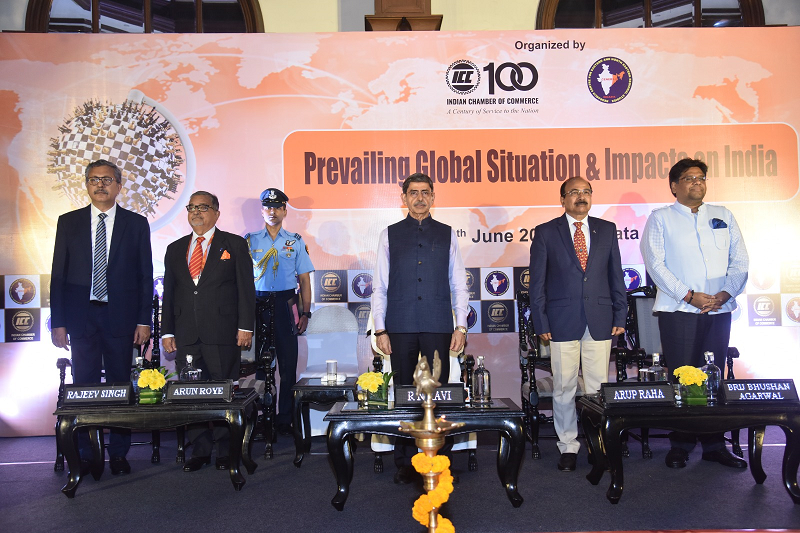
Kolkata, 7 June 2026: The Indian Chamber of Commerce (ICC), hosted a session on “Prevailing Global Situation & Impacts on India”, bringing together policymakers, strategic affairs experts, defence leaders and economists to discuss the security and economic implications of the evolving global landscape on India. The programme was graced by Chief Guest His Excellency R. N. Ravi, Hon’ble Governor of West Bengal, and featured addresses by Mr. Brij Bhushan Agarwal, President, Indian Chamber of Commerce, Dr. Rajeev Singh, Director General, Indian Chamber of Commerce; Chairman & Managing Director Shyam Metalics and Energy Limited, Arup Raha, PVSM, AVSM, VM, ADC (Retd.), Former Chief of the Air Staff, Indian Air Force, Member – Ceners-K.
The event was also graced by the presence of Gen. M.M. Naravane,PVSM, AVSM, VSM, SM (Retd.),Former Chief of the Army Staff, Dr. Srikant Kondapalli, Prof. of China Studies, Jawaharlal Nehru University, Mr. Nitin Gokhale, Eminent defense analyst, Media entrepreneur, Author, Strategic affairs commentator; CEO, Editor-in-Chief of BharatShakti.in, Mr. Bharat Karnad, Distinguished strategic thinker and author, widely regarded as a leading voice on India’s nuclear doctrine and geopolitical strategies, • Prof. Prabhat Patnaik, Formerly with Centre for Economic Studies and Planning, Jawaharlal Nehru University.(Virtual appearance), Prof. Alok Ray, Former Professor, Calcutta University & IIM, Kolkata, Dr. Shamika Ravi, EAC-PM, Government of India, Lt. Gen. J R Mukherjee, PVSM, AVSM, VSM (Retd.), Member Emeritus Ceners-K, Brig. N S Mukherjee, SM, VSM (Retd.), Executive Director, Ceners-K, Mr. J.N. Choudhury, IPS (Retd.), Vice President, Ceners-K, Maj. Gen. Arun Roye, AVSM, VSM (Retd.), President, Ceners-K.
While welcoming the audience to the opening session, Mr. Brij Bhushan Agarwal, President, Indian Chamber of Commerce, Chairman & Managing Director, Shyam Metalics and Energy Limited, said, “The theme of prevailing global situations and their impact in India is highly relevant at a time when the world is going through major geopolitical, economic and technology challenges. We are witnessing a sea change — a transformation happening in technology and in the innovation of AI and other new values that are being created for the new world. India is one of the fastest growing major economies and is not only adapting to these changes, but also playing a very important role in shaping the future. As India navigates the rapidly changing world, our greatest strength lies in the unity, resilience and shared vision of our people. Together, we have the confidence and capability to turn challenges into larger, greater opportunities and build a stronger future for generations to come.”
ACM Arup Raha, PVSM, AVSM, VM, ADC (Retd.), Former Chief of the Air Staff, Indian Air Force, Member – Ceners-K in his opening address to the opening session said, “The global environment has never been peaceful or tranquil. The underlying factors that cause upheavals in the world need to be studied thoroughly so that we can understand their impacts and work out solutions for our own country that are workable. India is actually an oasis in the desert of instability all around us — be it political, economic, or military upheavals. Our focus in this seminar is going to be identifying the problem areas, an incisive dissection of the problems and their effects, and working out solutions for India so that we can shield ourselves from the ill effects of such revolutionary changes occurring all around us. We have many problems, weaknesses, as well as strengths. We have to study all of them and focus in such a way that we can reduce our vulnerabilities.”
Speaking on this occasion, His Excellency R. N. Ravi, Honourable Governor of West Bengal, said, “Bharat existed for thousands of years as one society. That is why our people called it Rashtra. This unity in apparent diversity is the foundational idea of Bharat. People with different languages, food habits and climates have all shared a worldview and shared vision. This civilizational consciousness and assertion — the national awakening of who we are — matters because Bharat has to grow into a fully developed Bharat by 2047 with an idea of who we are: a confident Bharat with national awakening. The present developments across the world also offer us opportunities, not just challenges. The opportunity for Bharat is to reshape a new world order. The new world is not just shaping a new Bharat; Bharat is shaping the new world according to our civilizational values. And our civilizational value is Vasudhaiva Kutumbakam. Bharat is looked upon by the Global South and much of the world with hope, because when we rise, we do not rise at the cost of others. We rise as shared prosperity.”
While delivering the vote of thanks, Dr. Rajeev Singh, Director General, Indian Chamber of Commerce, said, “Post-2019, things have changed rapidly. India, as we know, is a very large, vast, very complex country, and it is facing challenges that are external. We have seen several challenges, and I must say the government has responded extremely well to all of them. Prime Minister Modi sees in every aapda an opportunity. He has not been reactive to the challenges. Rather, he has been proactive, and India has turned challenges into opportunities. Look at supply chains, look at global partnerships, the way the Honourable PM engages with the world — that is giving us a huge opportunity. The destination is India becoming a developed country by 2047, and that is where all of us also have a role to play. Bengal should aim to be the number one state in the country again, and ICC would like to partner with the state and be a part of this journey.”
During the session on Security Implications on India, Gen. M.M. Naravane, PVSM, AVSM, VSM, SM (Retd.), Former Chief of the Army Staff, said, “As far as India’s stance on various international issues is concerned, we have always maintained our policy of strategic autonomy. Strategic autonomy means we take a principled approach on various issues without aligning ourselves to any bloc or alignment. Whether it be the Quad, for example, or BRICS, it is based on what the government feels is best for our country at that point of time. That decision at that point of time is in the best interest of the country, and only time will tell whether that approach was correct or incorrect.”
Mr. Bharat Karnad, Distinguished Strategic Thinker and Author, widely regarded as a leading voice on India’s nuclear doctrine and geopolitical strategies, added, “We have always to learn from opportunities as they arise. Pakistan is very agile in catching on to small little interstices of opportunities that crop up. We, on the other hand, are not very nimble or agile in our policies or in our diplomacy. We should be more agile. If we lose Iran, we pretty much are stuck with only IMEC, and we cannot have our interests being held hostage by just one corridor. We have to begin to stand up for our interests. Why are we listening to the Americans to decide where we should source our energy from? The message we have telegraphed to the world is that we’ll do Washington’s bidding. I’m sorry, this is not strategic autonomy. We are simply becoming blind to the choices we have.”
While delivering his valedictory address, Lt. Gen. J. R. Mukherjee, PVSM, AVSM, VSM (Retd.), Member Emeritus, Ceners-K, said, “India is badly affected by developments in the Middle East. Best is if we can stand on our own. People talk about strategic autonomy. We must maintain our strategic autonomy, irrespective of the consequences. I have served all along the Chinese border and watched the Chinese all my life. I wonder now, is there a possibility that we do a deal with China? Because if we do a deal, can we settle the problem with China and then divert resources. What is happening in Manipur and Nagaland today is a disgrace. It is a disgrace to India. Without a proper economy, we are in trouble. The most important thing is the economy and making sure we have oil.”