Bangalore, 2 July: Skyroot Aerospace today announced the opening of the launch window for the maiden test flight of its Vikram–1 launch vehicle — India’s first privately developed orbital-class rocket. Test Flight-1 is targeted for no earlier than July 12, subject to the completion of assembly and testing operations at the launch site in SDSC-SHAR, Sriharikota, and weather, safety, and range clearance. The window extends till 4 August.
The single most important objective of Mission Aagaman is to capture the real in-flight performance data from every system on Vikram–1. We want to understand how the vehicle performs from lift-off through every phase of ascent. This data cannot be fully replicated through ground testing. It will help us validate our designs and inform subsequent vehicle development as we build a reliable, high-cadence commercial launch programme. The moment Vikram–1 lifts off, India’s private space industry will cross a threshold it has never crossed before.
— Pawan Kumar Chandana, Co-founder & CEO, Skyroot Aerospace.
Mission Aagaman, meaning “the arrival”, marks Skyroot’s second mission following the successful suborbital flight of Vikram-S, the first private rocket to reach space from Indian soil, on 18 November 2022.
This will be partially commercial flight, with the company planning to commence full commercial flights after one or two successful demonstrations to orbit. Joining the test flight is a mix of domestic and international customers.
From a dream to build a launch vehicle in India to now attempting an orbital flight has been a journey like no other. With Vikram-S in 2022, we validated the foundation of our technology stack; With Vikram–1, we take our biggest step, yet toward a reliable, high-cadence launch programme built in India, for India and the world. This mission is designed as both a technology demonstration and a learning mission. This has been made possible by the collective confidence of the Government of India, IN-SPACe, ISRO, our investors, our customers and a dedicated team of 1000+ individuals.
— Naga Bharath Daka, Co-founder & COO, Skyroot Aerospace
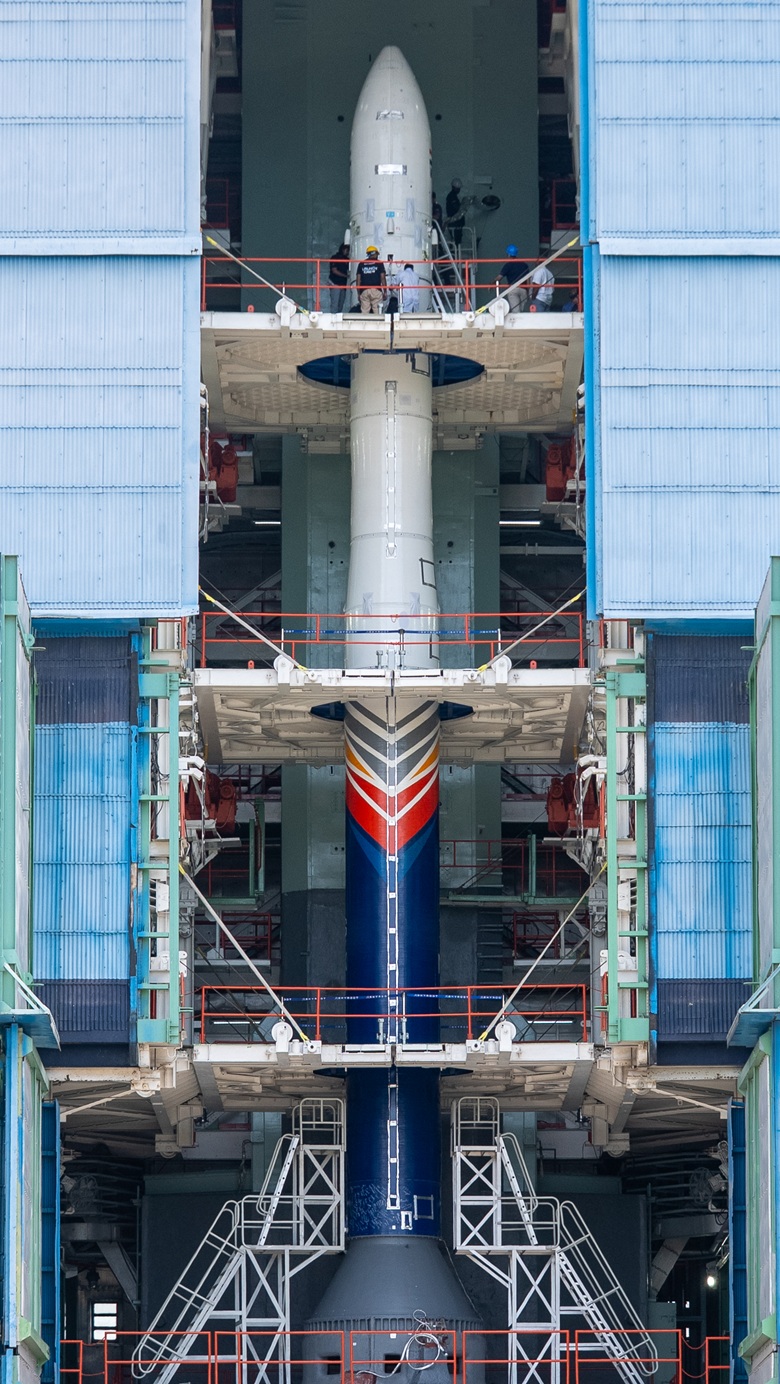
All stages of Skyroot‘s Vikram–1 have been successfully integrated and stacked at the launch pad.
The mission will gather critical data across propulsion, stage separation, guidance, navigation, control and overall vehicle performance, supporting the evolution of Skyroot into a commercially operational launch company.
Vikram–1 is a seven-storey-tall, multi-stage orbital launch vehicle built with an all-carbon composite structure and powered by in-house developed propulsion systems, including 3D-printed engines and high-thrust solid-fuel rocket boosters. Designed to carry small satellites weighing up to 350 kg to Low Earth Orbit (LEO), Vikram–1‘s maiden mission will target an orbit at an altitude of 450 km with a 60-degree orbital inclination. The flight-ready rocket was unveiled by Prime Minister Shri Narendra Modi in November 2025 during the inauguration of Skyroot’s Infinity campus.
For India, the ability to reach orbit reliably and frequently is a strategic capability that only a handful of nations possess. Today, access to space remains a major bottleneck, with satellite operators often waiting months or even years for a launch opportunity. Backed by IN-SPACe’s efforts to open India’s space sector and ISRO’s technical infrastructure, Skyroot‘s Cab to Space model aims to provide dedicated and precise access to orbit.
Satellites support services that millions rely on every day, from agriculture and fisheries to disaster management, communications, connectivity, navigation and national security. Frequent and affordable access to orbit is what enables these capabilities to be built and scaled within India.
The economic opportunity is equally significant. India’s space economy is expected to grow from around USD 8.4 billion today to USD 44 billion by 2033. Indigenous launch capability will be a critical enabler of this growth, unlocking opportunities for India’s rapidly expanding private space ecosystem. The emergence of companies such as Skyroot, India’s first spacetech unicorn, signals both the scale of investor confidence in the sector and the growing maturity of the country’s commercial space ambitions.