OOTY, India, Sept. 3, 2026 /PRNewswire/ — Microland Foundation is strengthening its commitment to environmental sustainability through initiatives that focus on restoring local ecosystems, building environmental awareness and enabling communities to play an active role in protecting their surroundings.
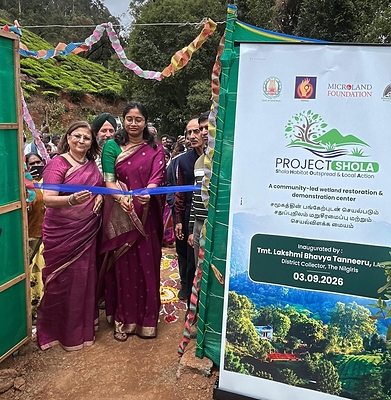
As part of this commitment, Project SHOLA (Shola Habitat Outspread & Local Action) – Community-Led Wetland Restoration and Demonstration Centre has been launched in the Upper Nilgiris. The initiative brings together the Nilgiris District Administration, Microland Foundation, Edhkwehlynawd Botanical Refuge (EBR), District Forest Officer, Government of Tamil Nadu and Tamil Nadu State Rural Livelihood Mission (TNSRLM), along with the active participation of civil society, NGOs, local & tribal leaders, the Kota Tribe community and Women Self-Help Groups.
The project focuses on restoring degraded wetlands and conserving the interconnected shola, grassland and wetland ecosystems of the Upper Nilgiris. These ecosystems play an important role in supporting biodiversity, water security and local communities. The Centre at Katlada Bridge, Doddacombai, will serve as a space for native plant propagation, restoration activities, community training and environmental education. A native plant nursery is established to produce locally suitable planting materials for wetland, shola and grassland restoration.
A key focus of Project SHOLA is to make the community an active part of the restoration process. The Kota Tribe community and Women SHGs will participate in activities such as native seed collection, nursery development, plant propagation, restoration and maintenance. The initiative will help build local skills and create livelihood opportunities linked to nursery and restoration activities. It will also provide opportunities for students, visitors and other stakeholders to learn about the unique ecosystems of the Nilgiris and understand the importance of protecting them.
Speaking about the importance of community participation and Public-Private-Partnership, Kalpana Kar, Managing Trustee, Microland Foundation, said, “For us, community participation is at the heart of Project SHOLA. It is important that communities are aware of the value of the ecosystems around them and have the opportunity to participate in protecting and restoring them. This is not about doing something for the community; it is about working with the community, bringing together their knowledge and experience with technical expertise, and creating a sense of ownership that can sustain the work for the long term.”
Project SHOLA is part of Microland Foundation’s broader environmental work in the Nilgiris, with a strong focus on building better waste management and sanitation systems across the district. This includes on-ground waste management initiatives in locations such as Coonoor and Masinagudi. The Foundation has also undertaken capacity building for sanitation workers and sanitary inspectors, through a first-of-its-kind training initiative in the Nilgiris focused on strengthening the people and systems responsible for sanitation and waste management. Together, these efforts reflect Microland Foundation’s approach of working at both the community and systems level to address environmental challenges in the district.
Tmt. Lakshmi Bhavya Tanneeru, I.A.S., District Collector, The Nilgiris, said, “The Nilgiris has a unique and fragile ecosystem, and protecting it requires sustained effort and participation from all those who are connected to the landscape. It is encouraging to see restoration, community participation and livelihood opportunities coming together through one initiative. We hope that the learning from this effort will help strengthen similar conservation efforts across the district.”
The initiative brings together the strengths of its partners, with ecological and restoration expertise, government support and community participation coming together with Microland Foundation’s commitment to supporting meaningful and sustainable environmental action.
Dr. Tarun Chhabra, Founder, Edhkwehlynawd Botanical Refuge (EBR) Centre Trust, said, “Restoration is not simply about planting more trees or removing invasive species. It is about understanding the landscape, restoring its natural processes and bringing back the native biodiversity that belongs here. The Centre will demonstrate practical approaches to wetland restoration, native plant propagation, invasive species management, shola-grassland restoration and nursery development.”
For Microland Foundation, environmental sustainability is not limited to restoring a particular site. It is about creating greater awareness, building local skills and enabling communities to take ownership of the environment around them.
About Microland Foundation
Established in 2016, Microland Foundation is advancing inclusive, lasting social change across four interconnected priorities: Employability, Health, Education, and Environment. We work alongside communities to design solutions that respond to their most urgent needs while building the confidence, capabilities, and systems required for long-term progress. Our initiatives harness technology, innovation, and local knowledge, recognising that complex challenges cannot be solved in isolation. By connecting our programmes across sectors, we create stronger pathways to opportunity, wellbeing, learning, and environmental resilience. At the heart of our approach is a commitment to incubating bold ideas, enabling community ownership, and building models that can be replicated and scaled for wider impact. We combine experimentation with deep respect for cultural traditions and lived experience, ensuring that every solution is relevant, sustainable, and rooted in the aspirations of the people it serves. Meaningful impact is a shared endeavour. Microland Foundation actively collaborates with NGOs, civil-society organisations, government agencies, and other mission-aligned partners to unlock collective expertise and resources. Together, we are helping communities move beyond immediate challenges towards a more equitable, resilient, and opportunity-rich future.
About EBR Center Trust
The Edhkwehlynawd Botanical Refuge (EBR) Centre Trust is a dedicated organization established to address the urgent need for both ecological restoration and cultural conservation in the Nilgiris, South India. With its roots deeply connected to the Toda people, the Trust seeks to protect and revitalize the natural landscape that has been under threat from human activities and environmental degradation. The Trust operates with a multi-faceted approach to conservation, combining scientific research, traditional ecological knowledge, and community involvement. Its initiatives focus on restoring native ecosystems, particularly the shola-grassland mosaic unique to the Nilgiri Biosphere Reserve. By reintroducing endemic plant species and addressing habitat loss, EBR strives to bring balance back to areas where biodiversity has been diminished.
For more information, visit: https://www.microland.com/about/microland-foundation
Media Contact: mohammedabaubacker.ali@microland.com
 View original content to download multimedia:https://www.prnewswire.com/in/news-releases/microland-foundation-supports-project-shola-to-restore-upper-nilgiris-wetlands-and-empower-community-led-conservation-302868990.html

