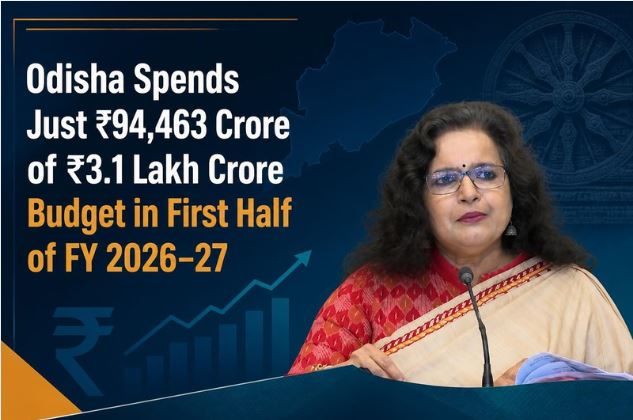
Bhubaneswar, Oct 14 (UDN): Odisha spent ₹94,463 crore, roughly 30 per cent of its ₹3.1 lakh crore annual budget, during the first six months of the 2026–27 financial year, with capital expenditure remaining significantly below the yearly target.
Representational Image
The expenditure figures were presented by the Finance Department at a recent meeting of departmental secretaries, prompting directions to accelerate spending and remove bottlenecks delaying the implementation of development projects.
Capital Expenditure Lags Behind
Of the ₹1.8 lakh crore allocated for programme expenditure in the current financial year, the state had spent ₹58,508 crore by the end of September, according to reports.
Capital expenditure stood at ₹18,183 crore against the annual allocation of ₹72,100 crore, meaning roughly one-fourth of the planned amount had been utilised in the first half of the financial year.
Meanwhile, expenditure on establishment, operations and maintenance declined by around 4.1 per cent in absolute terms compared with the corresponding period last year.
CAG Flags Persistent Underspending
The latest figures come against the backdrop of a Comptroller and Auditor General (CAG) report highlighting substantial budgetary savings over five financial years.
Between 2020–21 and 2024–25, Odisha reportedly underspent its capital outlay by an average of 17 per cent and its overall budget by 20 per cent. Savings against budgetary provisions ranged from 17.7 per cent to 25.98 per cent during the period.
The state budget expanded from ₹1,67,663 crore in 2020–21 to ₹2,87,770 crore in 2024–25, an increase of 71.64 per cent. The figures raise questions about the pace at which budget allocations are being translated into actual expenditure and completed projects.
Vacancies and Delays Cited as Key Challenges
Amarendra Das, associate professor at the National Institute of Science Education and Research (NISER), attributed lower-than-expected expenditure partly to vacancies in government departments and delays in the release of central funds.
Administrative hurdles, including delays in preparing detailed project reports (DPRs), tender finalisation, committee appraisal and Cabinet approvals, have also been identified as areas requiring attention.
Departments Told to Accelerate Spending
Chief Secretary Anu Garg has directed departmental secretaries to closely monitor expenditure and speed up the implementation of schemes, particularly those involving programme and capital spending.
Engineering departments have been asked to expedite project execution and achieve at least 10 per cent growth in expenditure over the next six months.
Officials have also been instructed to identify implementation bottlenecks, resolve pending approvals on priority and fix accountability for avoidable delays.
With the financial year entering its second half, the focus will be on whether departments can accelerate spending and ensure that budgetary allocations translate into timely infrastructure development and public services.
