
Marketing has always been a blend of creativity, communication, and understanding human behaviour. From designing eye-catching advertisements to building strong brand identities, creativity has played a central role in shaping successful marketing strategies. However, the rapid development of Artificial Intelligence (AI) is transforming the marketing industry and redefining how businesses connect with their audiences.
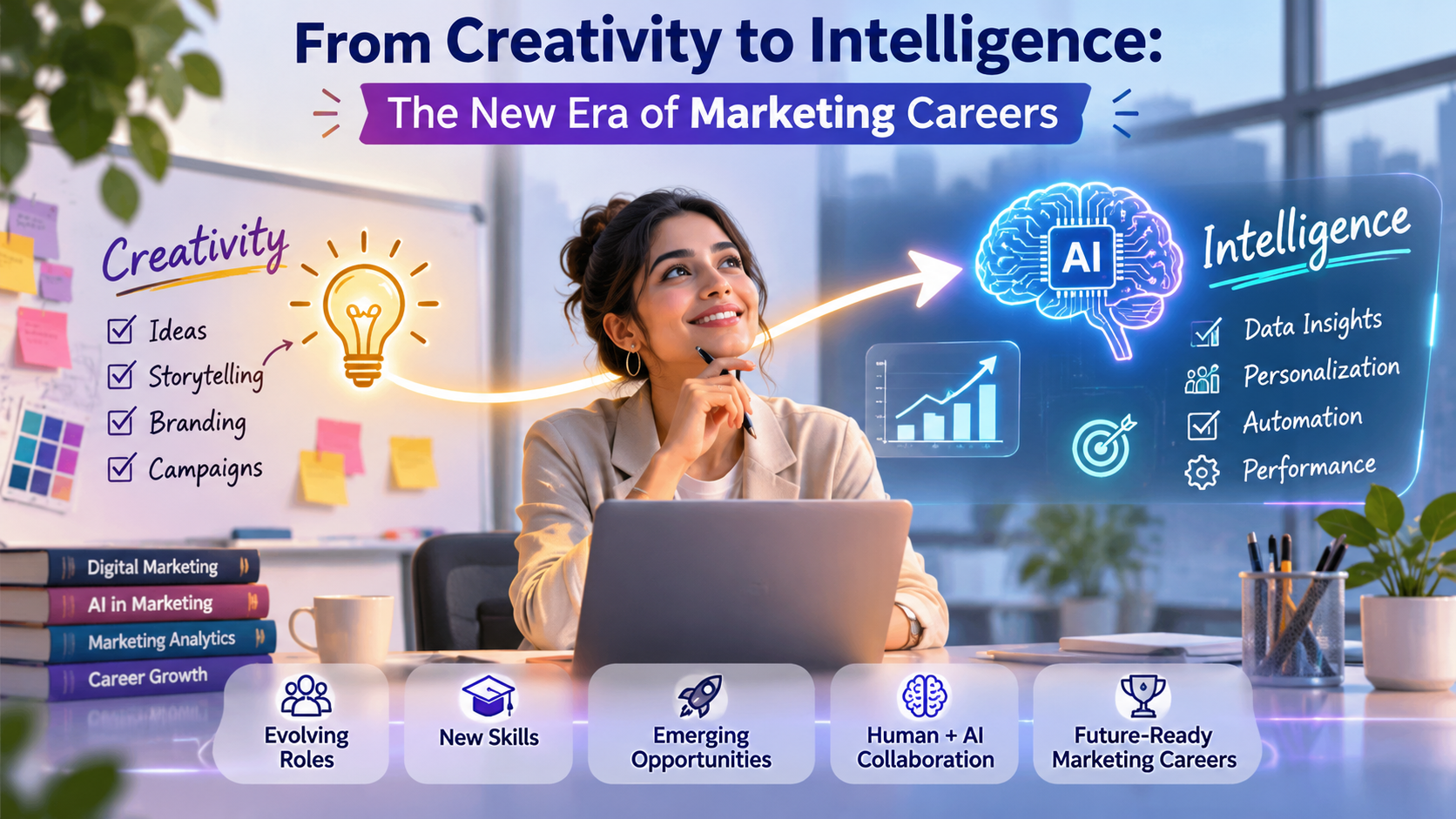
Today, marketing is no longer driven by creativity alone. It is increasingly powered by data, automation, predictive analytics, and intelligent technologies. AI is changing how marketers research markets, understand customers, create content, analyse campaigns, and make business decisions. This transformation marks the beginning of a new era in marketing careers, where human creativity and artificial intelligence work together to deliver smarter and more effective results.
The Evolution of Marketing in the AI Era
Traditional marketing primarily relied on human intuition, market research, experience, and creative thinking. Marketers developed campaigns based on customer surveys, observations, and historical trends. Although these methods were valuable, they often required considerable time and resources.
With the introduction of AI, marketing has become more data-driven and technology-oriented. AI-powered tools can process enormous amounts of information, identify consumer patterns, predict market trends, and generate insights within seconds.
For example, businesses can now analyse customer preferences, recommend personalised products, and optimise advertisements based on individual behaviour. This shift has transformed marketing from a largely intuition-based activity into a more intelligent and analytical profession.
How AI Is Transforming Marketing Careers
Artificial Intelligence is not simply changing marketing activities; it is also creating new career opportunities and transforming existing job responsibilities.
Some of the major changes include:
A. AI-Powered Digital Marketing
Digital marketers are increasingly using AI tools to optimise advertising campaigns, improve search engine rankings, analyse website traffic, and identify potential customers. Professionals who understand both digital marketing and AI technologies have a growing advantage in the job market.
B. Content Creation and Creative Marketing
AI-powered platforms can generate blog ideas, social media captions, marketing emails, advertisements, and visual concepts. This allows content creators to save time and focus more on storytelling, brand identity, and creative strategy.
However, human creativity remains essential for developing authentic messages that connect emotionally with audiences.
C. Data-Driven Marketing and Analytics
Modern marketers need to understand data rather than simply create promotional campaigns. AI tools help analyse customer behaviour, measure campaign performance, identify trends, and support better marketing decisions.
This has increased the importance of analytical thinking and data interpretation in marketing careers.
D. Personalised Customer Experiences
AI enables businesses to deliver personalised recommendations, targeted advertisements, and customised communication. Marketing professionals can use customer data to create experiences that are more relevant to individual needs and interests.
E. Marketing Automation
Tasks such as email scheduling, customer segmentation, lead management, and campaign reporting can now be automated. As a result, marketers can spend more time on strategic planning, relationship building, and creative decision-making.
Emerging Career Opportunities in AI-Driven Marketing
The integration of Artificial Intelligence into marketing is creating new career opportunities while transforming existing roles. Emerging positions include AI Marketing Specialist, Marketing Data Analyst, SEO and AI Search Specialist, Marketing Automation Specialist, AI Content Strategist and Customer Experience Analyst. These professionals use AI tools, customer data and automation to improve marketing strategies, optimise campaigns and enhance customer engagement.
As AI continues to reshape the marketing industry, roles such as Performance Marketing Manager and AI-driven content strategist are also gaining importance. The future of marketing will increasingly depend on a combination of technological knowledge, data analysis, strategic thinking, communication skills and human creativity.
The Changing Skill Set: What Will Future Marketers Need?
As AI becomes an important part of marketing operations, the skills required to build a successful marketing career are also evolving.
Future marketing professionals will need to develop a balanced combination of technical and human skills.
Technical Skills:
-
AI tools and prompt engineering.
-
Digital marketing and SEO.
-
Data analytics and interpretation.
-
Marketing automation.
-
Social media analytics.
-
Customer relationship management (CRM) platforms.
Human Skills:
-
Creative and critical thinking.
-
Communication and storytelling.
-
Emotional intelligence.
-
Problem-solving and decision-making.
-
Leadership and collaboration.
-
Adaptability and continuous learning.
The most successful marketers will not necessarily be those who know how to use the greatest number of AI tools. They will be those who know how to use technology strategically while bringing human insight and originality to their work.
Will AI Replace Human Marketers?
One of the biggest questions surrounding the future of marketing is whether Artificial Intelligence will replace human professionals.
AI can perform repetitive tasks, analyse large datasets, generate content, and automate several marketing activities. However, marketing involves more than processing information. It requires understanding emotions, cultural differences, social behaviour, brand values, and human relationships.
For instance, AI may generate an advertisement, but a human marketer must evaluate whether its message reflects the brand’s identity and connects meaningfully with the target audience.
Similarly, AI can identify consumer preferences, but human professionals play an important role in interpreting complex motivations and making ethical decisions.
Therefore, rather than viewing AI as a complete replacement for marketers, it is more useful to understand it as a tool that enhances human capabilities. Nevertheless, professionals who fail to adapt to changing technologies may find certain traditional marketing roles increasingly challenging.
Challenges of AI in Marketing Careers
Although AI offers significant opportunities, its integration into marketing also creates several challenges.
-
Job displacement: Automation may reduce the demand for certain repetitive and routine marketing tasks.
-
Skill gaps: Professionals who lack knowledge of AI and digital technologies may struggle to remain competitive.
-
Data privacy: The collection and use of customer information raise important privacy and security concerns.
-
Content originality: Excessive dependence on AI-generated content can reduce originality and weaken brand authenticity.
-
Ethical concerns: AI-generated misinformation, algorithmic bias, and misleading advertisements can damage consumer trust.
To overcome these challenges, marketing professionals must continuously upgrade their skills, use AI responsibly, and maintain a balance between technological efficiency and human judgement.
How Students and Young Professionals Can Prepare for the Future
For students pursuing careers in marketing, business administration, management, or digital communication, the AI revolution presents an opportunity to develop valuable professional skills.
Here are some practical steps to prepare for the changing marketing landscape:
-
Learn AI tools: Explore platforms such as ChatGPT, Canva AI, and other AI-powered marketing applications.
-
Develop digital marketing skills: Understand SEO, social media marketing, email marketing, and online advertising.
-
Build analytical abilities: Learn how to interpret marketing data and measure campaign performance.
-
Strengthen creativity: Practise storytelling, content development, branding, and innovative campaign planning.
-
Gain practical experience: Work on live projects, internships, case studies, and personal marketing campaigns.
-
Stay updated: Follow emerging technologies, industry developments, and changing consumer trends.
The combination of practical experience, technological awareness, and human creativity can help young professionals build successful careers in the evolving marketing industry.
The Future: Human Creativity Meets Artificial Intelligence
The future of marketing will not be defined by technology alone. Instead, it will be shaped by the collaboration between human intelligence and artificial intelligence.
AI will continue to improve efficiency, personalise customer experiences, and support faster decision-making. Meanwhile, human marketers will remain important for creative direction, emotional connection, strategic thinking, and building long-term brand relationships.
The next generation of marketing professionals will need to move beyond traditional job responsibilities and become adaptable, technology-driven, and strategically minded individuals.
The real competitive advantage will belong to marketers who can combine the analytical power of AI with the originality and emotional intelligence of human creativity.
Conclusion
The transition from creativity to intelligence represents a significant turning point in the marketing profession. Artificial Intelligence is transforming traditional marketing practices, introducing new career opportunities, and changing the skills required to succeed in the industry.
However, this transformation does not mean that creativity is becoming less important. Rather, creativity is gaining a new dimension through intelligent technologies. AI can provide speed, accuracy, and insights, but human beings provide imagination, empathy, originality, and purpose.
Ultimately, the future of marketing careers will not be about choosing between human creativity and artificial intelligence. It will be about combining both to create meaningful customer experiences and innovative business strategies.