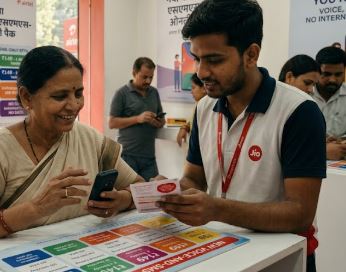
Sep 22: Not every mobile user needs a large data package. For some, a phone is still primarily a way to make calls, receive messages and remain connected with family, friends, customers or essential services.
Yet, finding a recharge plan designed specifically around those needs has not always been straightforward.
That could now change.
The Telecom Regulatory Authority of India (TRAI) has introduced a new set of rules aimed at expanding voice-and-SMS-only Special Tariff Vouchers (STVs), particularly across shorter validity periods. The move is expected to give consumers greater freedom to choose a mobile plan based on their actual usage instead of paying for services they may not need.
The Telecom Consumer Protection (Thirteenth Amendment) Regulations, 2026, released on September 22, require telecom operators to offer voice-and-SMS-only STVs corresponding to the validity periods of combined voice, SMS and data vouchers available for 30 days or less. The plans are also required to have an appropriately reduced tariff.
A recharge option built around real usage
The significance of the move lies in its simplicity.
India’s mobile market has changed dramatically over the years. Smartphones, high-speed internet and digital services have made data an essential part of everyday life for many people. But that does not mean every customer uses mobile data in the same way.
Some users may have Wi-Fi at home or work and need their mobile connection mainly for calls. Others may use a feature phone, while some customers may simply want an affordable connection for basic communication.
TRAI itself describes voice-and-SMS-only packs as prepaid plans that provide calling and messaging without data. Such plans are designed for consumers who do not require internet services and are currently available with validity periods of up to 365 days.
The latest rules aim to make this category more flexible, especially for shorter periods.
Why shorter validity can make a difference
For a consumer on a tight monthly budget, flexibility can be just as important as price.
A longer-duration recharge may offer convenience, but it may not suit someone who wants to manage expenses month by month. Similarly, paying for a data allowance that is rarely used can reduce the value of a mobile recharge.
Shorter voice-and-SMS-only plans could provide an alternative.
Users may be able to select a plan closer to the period for which they actually need connectivity. This could be useful for people with temporary communication needs, secondary SIM users, elderly customers, feature-phone users and households that want to keep basic connections active without taking a larger bundled package.
The new framework therefore has the potential to make mobile spending more targeted and predictable.
Monthly recharges get a clearer place
Another important feature of the new framework is the requirement for at least one voice-and-SMS-only STV that can be renewed on the same date every month.
If that date does not exist in a particular month, the renewal will take place on the last day of that month.
This could make monthly budgeting easier for consumers who prefer a regular recharge cycle. Instead of navigating different validity periods each time, customers will have a monthly option designed around a more familiar household budgeting pattern.
TRAI has also required operators to provide at least one voice-and-SMS-only STV with a validity longer than the monthly option, creating room for consumers who prefer to recharge less frequently.
A step towards more consumer-friendly telecom plans
The latest decision follows an earlier regulatory change.
In 2024, TRAI required telecom service providers to offer at least one Special Tariff Voucher exclusively for voice and SMS. However, the regulator later observed that only a limited number of such vouchers were being offered.
Representations received by TRAI also highlighted the need for shorter-duration voice-and-SMS-only packs. In response, the regulator proposed that whenever operators offered a particular validity period for combined voice, SMS and data STVs, a corresponding voice-and-SMS-only option should also be available, with a broadly proportional reduction in tariff.
That proposal has now evolved into the final 2026 regulations.
A consultation-led change
The new rules were not introduced overnight.
TRAI released the draft Thirteenth Amendment for public consultation on April 7, 2026. The consultation received 1,132 responses from stakeholders, after which the regulator conducted an Open House Discussion on June 15.
Following stakeholder feedback and its own analysis, TRAI finalised the amended regulations on September 22.
The consultation process is important because telecom pricing affects a wide range of consumers, from individual users and families to businesses and organisations that maintain multiple connections.
What consumers stand to gain
The potential benefits of the new framework are broader than simply having more recharge options.
Greater choice: Users who need only calling and SMS will have more plans to choose from.
Better budget control: Shorter validity options can help consumers manage mobile expenses according to their immediate needs.
Less spending on unused data: Customers who do not require internet services can choose plans focused on voice and messaging.
More flexibility: Monthly and longer-validity options can accommodate different usage patterns.
Better suitability for basic users: People who primarily depend on voice calls and SMS can access plans designed around those requirements.
Simpler decision-making: Instead of selecting a data-heavy bundle simply because of limited alternatives, consumers may have more targeted choices.
The actual savings, however, will depend on the prices and terms of the plans launched by individual telecom operators.
What it means for telecom companies
The regulation also brings a new dimension to competition in the prepaid market.
Telecom operators will need to broaden their voice-and-SMS-only offerings and align them with relevant validity periods. This could encourage greater segmentation of prepaid plans, with companies designing products for different categories of customers instead of relying mainly on broad bundled offerings.
For operators, the challenge will be to balance regulatory requirements with consumer demand and commercially viable pricing.
For customers, the increased range of choices could make it easier to compare plans based on price, validity and actual usage.
Beyond price, it is about choice
The most important aspect of the new framework may not be whether every consumer ends up paying less. It is the fact that consumers will have more scope to choose a plan that matches their requirements.
Telecom usage in India is increasingly diverse. One customer may consume several gigabytes of data every day, while another may use a phone almost entirely for voice calls. A student, a senior citizen, a small business owner and a rural household can all have very different connectivity needs.
A one-size-fits-all approach cannot necessarily serve all of them equally well.
TRAI’s latest regulations recognise that diversity and seek to create more room for customised consumer choices.
A small change with an everyday impact
Mobile recharges may appear to be a routine part of everyday life, but they are also a recurring household expense for millions of consumers.
Giving people greater control over what they buy can therefore have a meaningful impact.
With shorter voice-and-SMS-only options, monthly renewal choices and longer-validity alternatives, the new framework could make prepaid mobile services more adaptable to different budgets and communication habits.
For consumers who do not need mobile data, the message is straightforward: more choice, more flexibility and a greater ability to pay for the connectivity they actually use.
As India’s telecom sector continues to evolve, TRAI’s latest move adds another step towards making mobile services more closely aligned with the diverse needs of the people who use them.